erosmith's long-promised[129] blues album Honkin' on Bobo
was released in 2004. This was a return to the band's roots, including
recording the album in live sessions, working with former producer Jack Douglas, and laying down their blues rock grit.[129] It was followed by a live DVD, You Gotta Move, in December 2004,[9] culled from performances on the Honkin' on Bobo Tour. "Dream On" was also featured in an advertising campaign for Buick in 2004, targeting that marque's market which is now composed largely of people who were teenagers when the song first charted.[130]
2005 saw Steven Tyler appear in the film Be Cool.[131] Joe Perry released his self-titled solo album that same year.[132] At the 2006 Grammy Awards, he was nominated for Best Rock Instrumental Performance for the track "Mercy",[133] but lost to Les Paul. In October 2005, Aerosmith released a CD/DVD Rockin' the Joint.[9] The band hit the road for the Rockin' the Joint Tour on October 30 with Lenny Kravitz for a fall/winter tour of arenas in the largest U.S. markets.[134] The band planned to tour with Cheap Trick in the spring, hitting secondary markets in the U.S.[135] Almost all of this leg of the tour was canceled, however. Dates were initially canceled one by one[136]
until March 22, 2006, when it was announced that lead singer Steven
Tyler needed throat surgery, and the remaining dates on the tour were
subsequently canceled.[137]
Aerosmith commenced recording a new album on Armed Forces Day 2006.[138] Tyler and Perry performed with the Boston Pops Orchestra
for their annual July 4 concert on the Esplanade in 2006, a milestone
as it was the first major event or performance since Steven Tyler's
throat surgery.[139] Around this time, the band also announced that they would embark on the Route of All Evil Tour with Mötley Crüe in late 2006.[140] On August 24, 2006 it was announced that Tom Hamilton was undergoing treatment for throat cancer.
In order to make a full recovery, he sat out much of the Route of All
Evil Tour until he was well again. Former Joe Perry Project bassist David Hull substituted for Hamilton until his return.[141] On September 5, 2006, Aerosmith kicked off the Route of All Evil Tour with Mötley Crüe
in Columbus, Ohio. The co-headlining tour took both bands to
amphitheaters across North America through November 24. After that, a
select few arena dates were added, some of which were with Mötley Crüe.
The tour ended December 17.[142]
On October 17, 2006, the compilation album Devil's Got a New Disguise: The Very Best of Aerosmith was released. The album contained previous hits with the addition of two new songs, "Devil's Got a New Disguise" and "Sedona Sunrise", which were older outtakes re-recorded for the album.[143] "Devil's Got a New Disguise" peaked at number 15 on the Mainstream Rock Tracks chart.[50]
The album was intended to fulfill Aerosmith's contract with Sony and
tide fans over until the band's new studio album was released.[144]
Friday, April 7, 2017

Nine Lives and "I Don't Want to Miss a Thing" (1996–2000)
Aerosmith had signed a $30 million contract for four records[102] with Columbia Records/Sony Music in 1991, but had only recorded three of their six contractual albums with Geffen Records at that point (Done with Mirrors, Permanent Vacation, and Pump). Between 1991 and 1996, they released two more albums with Geffen (Get a Grip and Big Ones),
which meant they now had five albums with Geffen under their belt
(along with a planned live compilation), which meant they could now
begin recording for their new contract with Columbia.[9][103] The band took time off with their families before working on their next album, Nine Lives, which was plagued with personnel problems, including the firing of manager Tim Collins,[9] who, according to band members, had nearly caused the band to break up.[104] The album's producer was also changed from Glen Ballard to Kevin Shirley.[105] Nine Lives was released in March 1997. Reviews were mixed, and Nine Lives initially fell down the charts,[9] although it had a long chart life and sold double platinum in the United States alone,[39] fueled by its singles, "Falling in Love (Is Hard on the Knees)", the ballad "Hole in My Soul", and the crossover-pop smash "Pink" (which won the band their fourth Grammy Award in 1999 in the Best Rock Performance by a Duo or Group with Vocal category).[77] It was followed by the over two-year-long Nine Lives Tour, which was plagued by problems including lead singer Steven Tyler injuring his leg at a concert,[106] and Joey Kramer suffering second degree burns when his car caught fire at a gas station.[107]
 In 1998, in the midst of setbacks during the Nine Lives Tour, the band released the single "I Don't Want to Miss a Thing", the love theme, written by Diane Warren for the 1998 film Armageddon, starring Steven Tyler's daughter Liv.[108] The song became Aerosmith's first and only number 1 single[50] when it debuted at the top position on the Billboard Hot 100 and stayed on top of the charts for four weeks.[69] The song was nominated for an Academy Award in 1999.[109] The song helped open Aerosmith up to a new generation[110] and remains a slow-dance staple.[111] 1998 also saw the release of the double-live album, A Little South of Sanity, which was assembled from performances on the Get a Grip and Nine Lives tours.[112] The album went platinum shortly after its release.[39] The band continued with their seemingly neverending world tours promoting Nine Lives and the "I Don't Want to Miss a Thing" single well into 1999.[113]
In 1999, Aerosmith was featured in the Disney Hollywood Studios at Walt Disney World (and later in 2001 at Disneyland Paris in the Walt Disney Studios Park) ride, Rock 'n' Roller Coaster Starring Aerosmith, providing the ride's soundtrack and theme.[114] On September 9, 1999, Steven Tyler and Joe Perry reunited with Run–D.M.C. and were also joined by Kid Rock for a collaborative live performance of "Walk This Way" at the MTV Video Music Awards, a precursor to the Girls of Summer Tour.[115] The band celebrated the new millennium with a brief tour of Japan,[116] and also contributed the song "Angel's Eye" to the 2000 film Charlie's Angels.[117] In December 2000, they wrapped up work on their next album.[118]
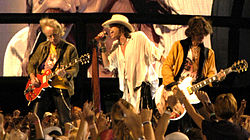
The band entered their next decade by performing at the halftime show for Super Bowl XXXV, in January 2001, along with pop stars 'N Sync, Britney Spears, Mary J. Blige, and Nelly. All of the stars collaborated with Aerosmith at the end for a performance of "Walk This Way".[119]
In March 2001, the band released their 13th studio album Just Push Play, which quickly went platinum,[39] fueled by the Top 10 single "Jaded"[50] and the appearance of the title track in Dodge commercials.[120] They were inducted to the Rock and Roll Hall of Fame soon after their album was released, in late March 2001.[56] Aerosmith is the only band to be inducted to the Hall of Fame with a song active in the charts ("Jaded").[69] Later that year, the band performed as part of the United We Stand: What More Can I Give benefit concert in Washington D.C. for 9/11 victims and their families.[121] The band flew back to Indianapolis for a show the same night, as part of their Just Push Play Tour.[122]
The band started 2002 by ending the Just Push Play tour, and simultaneously recording segments for their Behind the Music special on VH1, which not only chronicled the band's history but also the band's current activities and touring. The special was one of the few Behind the Musics to run two hours in length.[123] In May, Aerosmith covered the "Theme from Spider-Man" for the soundtrack of the 2002 film of the same name.[124] On June 27, the band performed at the official FIFA World Cup concert at Tokyo Stadium which took place during the 2002 FIFA World Cup held in Japan/Korea.[125] In July 2002, Aerosmith released a two-disc career-spanning compilation O, Yeah! Ultimate Aerosmith Hits, which featured the new single "Girls of Summer" and embarked on the Girls of Summer Tour with Kid Rock and Run–D.M.C. opening.[126] O, Yeah! has since been certified double platinum.[39] MTV honored Aerosmith with their mtvICON award in 2002. Performances included Pink covering "Janie's Got a Gun". Shakira performed "Dude (Looks Like a Lady)", Kid Rock played "Mama Kin" and "Last Child", Train performed "Dream On" and Papa Roach covered "Sweet Emotion". In addition, testimonials featured surprise guests Metallica, as well as Janet Jackson, Limp Bizkit singer Fred Durst, Alicia Silverstone and Mila Kunis.[127]
In 2003, Aerosmith co-headlined with Kiss on the Rocksimus Maximus Tour, in preparation for release of their blues album. They also performed a song for Rugrats Go Wild, "Lizard Love".[128]

The Rock 'n' Roller Coaster Starring Aerosmith opened at Walt Disney World in 1999.
In 1999, Aerosmith was featured in the Disney Hollywood Studios at Walt Disney World (and later in 2001 at Disneyland Paris in the Walt Disney Studios Park) ride, Rock 'n' Roller Coaster Starring Aerosmith, providing the ride's soundtrack and theme.[114] On September 9, 1999, Steven Tyler and Joe Perry reunited with Run–D.M.C. and were also joined by Kid Rock for a collaborative live performance of "Walk This Way" at the MTV Video Music Awards, a precursor to the Girls of Summer Tour.[115] The band celebrated the new millennium with a brief tour of Japan,[116] and also contributed the song "Angel's Eye" to the 2000 film Charlie's Angels.[117] In December 2000, they wrapped up work on their next album.[118]
Just Push Play, O, Yeah! and Rocksimus Maximus (2001–2003)

Brad Whitford, Steven Tyler, and Joe Perry of Aerosmith performing at the NFL Kickoff in Washington, DC on September 4, 2003
 |
|
| Problems playing this file? See media help. | |

In March 2001, the band released their 13th studio album Just Push Play, which quickly went platinum,[39] fueled by the Top 10 single "Jaded"[50] and the appearance of the title track in Dodge commercials.[120] They were inducted to the Rock and Roll Hall of Fame soon after their album was released, in late March 2001.[56] Aerosmith is the only band to be inducted to the Hall of Fame with a song active in the charts ("Jaded").[69] Later that year, the band performed as part of the United We Stand: What More Can I Give benefit concert in Washington D.C. for 9/11 victims and their families.[121] The band flew back to Indianapolis for a show the same night, as part of their Just Push Play Tour.[122]
The band started 2002 by ending the Just Push Play tour, and simultaneously recording segments for their Behind the Music special on VH1, which not only chronicled the band's history but also the band's current activities and touring. The special was one of the few Behind the Musics to run two hours in length.[123] In May, Aerosmith covered the "Theme from Spider-Man" for the soundtrack of the 2002 film of the same name.[124] On June 27, the band performed at the official FIFA World Cup concert at Tokyo Stadium which took place during the 2002 FIFA World Cup held in Japan/Korea.[125] In July 2002, Aerosmith released a two-disc career-spanning compilation O, Yeah! Ultimate Aerosmith Hits, which featured the new single "Girls of Summer" and embarked on the Girls of Summer Tour with Kid Rock and Run–D.M.C. opening.[126] O, Yeah! has since been certified double platinum.[39] MTV honored Aerosmith with their mtvICON award in 2002. Performances included Pink covering "Janie's Got a Gun". Shakira performed "Dude (Looks Like a Lady)", Kid Rock played "Mama Kin" and "Last Child", Train performed "Dream On" and Papa Roach covered "Sweet Emotion". In addition, testimonials featured surprise guests Metallica, as well as Janet Jackson, Limp Bizkit singer Fred Durst, Alicia Silverstone and Mila Kunis.[127]
In 2003, Aerosmith co-headlined with Kiss on the Rocksimus Maximus Tour, in preparation for release of their blues album. They also performed a song for Rugrats Go Wild, "Lizard Love".[128]
Get a Grip and Big Ones (1992–1995)
The band took a brief break before recording their follow-up to Pump in 1992. Despite significant shifts in mainstream music at the beginning of the 1990s,[12] 1993's Get a Grip was just as successful commercially, becoming their first album to debut at number 1[90] and racking up sales of 7 million copies in a two-and-a-half-year timespan.[39] The first singles were the hard rocking "Livin' on the Edge" and "Eat the Rich". Though many critics were unimpressed by the focus on the subsequent interchangeable power-ballads in promoting the album,[12] all three ("Cryin'", "Crazy" and "Amazing") proved to be huge successes on radio[50] and MTV.[64] The music videos featured then up-and-coming actress Alicia Silverstone; her provocative performances earned her the title of "the Aerosmith chick"[91] for the first half of the decade. Steven Tyler's daughter Liv Tyler was also featured in the "Crazy" video.[92] Get a Grip would go on to sell more than 7 million copies in the U.S. alone,[39] and over 20 million copies worldwide.[93] The band won two Grammy Awards for songs from this album in the category of Best Rock Performance by a Duo or Group with Vocal: for "Livin' on the Edge" in 1994 and "Crazy" in 1995.[77]
During the making of Get a Grip, the management and record company brought in a variety of professional songwriting collaborators to help give nearly all the songs on the album more commercial appeal,[12] a trend which would continue until the early 2000s. However, this led to accusations of selling out that would continue throughout the 1990s. In addition to Aerosmith's grueling 18 month world tour in support of Get a Grip, the band also did a number of things to help promote themselves and their album and appeal to youth culture, including the appearance of the band in the movie Wayne's World 2[94] where they performed two songs,[95] the appearance of the band and their music in the video games Revolution X[96] and Quest for Fame,[97] performing at Woodstock '94,[98] using their song "Deuces Are Wild" in The Beavis and Butt-head Experience,[99] and opening their own club, The Mama Kin Music Hall, in Boston, MA in 1994.[100] That same year saw the release of the band's compilation for Geffen Records, entitled Big Ones featuring their biggest hits from Permanent Vacation, Pump, and Get a Grip, "Deuces Are Wild" from the Beavis and Butt-head Experience, as well as two new songs, "Blind Man" and "Walk on Water",[101] both of which experienced great success on the rock charts.[50]
During the making of Get a Grip, the management and record company brought in a variety of professional songwriting collaborators to help give nearly all the songs on the album more commercial appeal,[12] a trend which would continue until the early 2000s. However, this led to accusations of selling out that would continue throughout the 1990s. In addition to Aerosmith's grueling 18 month world tour in support of Get a Grip, the band also did a number of things to help promote themselves and their album and appeal to youth culture, including the appearance of the band in the movie Wayne's World 2[94] where they performed two songs,[95] the appearance of the band and their music in the video games Revolution X[96] and Quest for Fame,[97] performing at Woodstock '94,[98] using their song "Deuces Are Wild" in The Beavis and Butt-head Experience,[99] and opening their own club, The Mama Kin Music Hall, in Boston, MA in 1994.[100] That same year saw the release of the band's compilation for Geffen Records, entitled Big Ones featuring their biggest hits from Permanent Vacation, Pump, and Get a Grip, "Deuces Are Wild" from the Beavis and Butt-head Experience, as well as two new songs, "Blind Man" and "Walk on Water",[101] both of which experienced great success on the rock charts.[50]
Permanent Vacation and Pump (1987–1991)
Permanent Vacation
was released in September 1987, becoming a major hit and the band's
bestselling album in over a decade (selling 5 million copies in the
U.S.),[39] with all three of its singles ("Dude (Looks Like a Lady)", "Rag Doll", and "Angel") reaching the Top 20 of the Billboard Hot 100.[50] Steven Tyler reveals in his autobiography that the album was "...the first one we ever did sober."[72] Part of Permanent Vacation's commercial success involved producer Bruce Fairbairn
whose production touches (such as sound effects and high-quality
recording) added interest to the album and the use of outside
songwriters such as Desmond Child, Jim Vallance, and Holly Knight
who assisted the band with lyrics. While the group was initially
hesitant to using outside songwriters, including Tyler being furious for
Knight getting songwriting credits for changing one word ("Rag Time"
became "Rag Doll"), the method paid off, as Permanent Vacation became the band's most successful album in a decade. The group went on a subsequent tour with labelmates Guns N' Roses
(who have cited Aerosmith as a major influence), which was intense at
times because of Aerosmith's new struggle to stay clean amidst Guns N'
Roses' well-publicized, rampant drug use.[73]
Aerosmith's next album was even more successful. Pump, released in September 1989, featured three Top Ten singles: "What It Takes", "Janie's Got a Gun", and "Love in an Elevator", as well as the Top 30 "The Other Side",[50] re-establishing the band as a serious musical force.[74] Pump was a critical and commercial success, eventually selling 7 million copies,[39] spawning several music videos that were in regular rotation on MTV, and achieving four-star ratings from major music magazines.[75] Pump ranked as the fourth-bestselling album of 1990.[76] The band also won its first Grammy in the category of Best Rock Performance by a Duo or Group with Vocal, for "Janie's Got a Gun".[77] In addition, the video for "Janie's Got a Gun" won two Video Music Awards and was ranked as one of the 100 greatest videos of all time by Rolling Stone, MTV, and VH1. Like Permanent Vacation, Pump
was produced by Bruce Fairbairn, who added production touches such as
instrumental interludes that provided transitions between songs to give
the album a more complete sound, as well as the Margarita Horns, who
added horns to tracks such as "Love in an Elevator" and "The Other
Side". Rock critic Stephen Thomas Erlewine claimed that Pump
"revels in [pop concessions] without ever losing sight of Aerosmith's
dirty hard rock core", going on to say that, "such ambition and
successful musical eclectism make Pump rank with Toys in the Attic and Rocks."[78] The recording process for Pump was documented in the video The Making of Pump, which has since been re-released as a DVD. The music videos for the album's singles were featured on the release Things That Go Pump in the Night, which quickly went platinum.[39]
 In support of Pump, the band embarked on the 12-month Pump Tour, which lasted for most of 1990.[79] On February 21, 1990, the band appeared in a "Wayne's World" sketch on Saturday Night Live, debating the fall of communism and the Soviet Union, and performed their recent hits "Janie's Got a Gun" and "Monkey on My Back".[80] The appearance of the band in the "Wayne's World" sketch was later ranked by E! as the number-one moment in the history of the program.[81] On August 11, 1990, the band's performance on MTV's Unplugged aired.[82] In October 1990, the Pump Tour ended, with the band's first ever performances in Australia.[83] That same year, the band was also inducted to the Hollywood Rock Walk.[84] In November 1991, the band appeared on The Simpsons episode "Flaming Moe's"[85] and released a box set titled Pandora's Box.[86] In coordination with the release of Pandora's Box,
the band's 1975 hit "Sweet Emotion" was re-mixed and re-released as a
single, and a music video was created to promote the single. Also in
1991, the band performed their 1973 single "Dream On" with Michael Kamen's orchestra for MTV's 10th Anniversary special; this performance was used as the official music video for the song.[87] In 1992, Tyler and Perry appeared live as guests of Guns N' Roses
during the latter's 1992 worldwide pay-per-view show in Paris,
performing a medley of "Mama Kin" (which GN'R covered in 1986) and
"Train Kept-A Rollin".[88][89]
In support of Pump, the band embarked on the 12-month Pump Tour, which lasted for most of 1990.[79] On February 21, 1990, the band appeared in a "Wayne's World" sketch on Saturday Night Live, debating the fall of communism and the Soviet Union, and performed their recent hits "Janie's Got a Gun" and "Monkey on My Back".[80] The appearance of the band in the "Wayne's World" sketch was later ranked by E! as the number-one moment in the history of the program.[81] On August 11, 1990, the band's performance on MTV's Unplugged aired.[82] In October 1990, the Pump Tour ended, with the band's first ever performances in Australia.[83] That same year, the band was also inducted to the Hollywood Rock Walk.[84] In November 1991, the band appeared on The Simpsons episode "Flaming Moe's"[85] and released a box set titled Pandora's Box.[86] In coordination with the release of Pandora's Box,
the band's 1975 hit "Sweet Emotion" was re-mixed and re-released as a
single, and a music video was created to promote the single. Also in
1991, the band performed their 1973 single "Dream On" with Michael Kamen's orchestra for MTV's 10th Anniversary special; this performance was used as the official music video for the song.[87] In 1992, Tyler and Perry appeared live as guests of Guns N' Roses
during the latter's 1992 worldwide pay-per-view show in Paris,
performing a medley of "Mama Kin" (which GN'R covered in 1986) and
"Train Kept-A Rollin".[88][89]
|
|
|
| Problems playing this file? See media help. | |

Aerosmith appear in a "Wayne's World" sketch on Saturday Night Live in 1990.
Back in the Saddle reunion tour, Done with Mirrors and drug rehab (1984–1986)
In 1984, Aerosmith embarked on a reunion tour called the Back in the Saddle Tour,[9] which led to the live album Classics Live II.
While concerts on the tour were well-attended, it was plagued with
several incidents, mostly attributed to drug abuse by band members.[9] Their problems still not behind them, the group was signed to Geffen Records and began working on a comeback.[64] Despite the band signing on to a new record company, the band's old label Columbia continued to reap the benefits of Aerosmith's comeback, releasing the live companion albums Classics Live I and II and the collection Gems.[65]
In 1985, the band released the album Done with Mirrors, their first studio album since reuniting. While the album did receive some positive reviews,[66] it only went gold[39] and failed to produce a hit single or generate any widespread interest.[50] The album's most notable track, "Let the Music Do the Talking", was in fact a cover of a song originally recorded by the Joe Perry Project and released on that band's album of the same name.[67] Nevertheless, the band became a popular concert attraction once again, touring in support of Done With Mirrors, well into 1986.[68] In 1986, Tyler and Perry appeared on Run–D.M.C.'s cover of "Walk This Way", a track blending rock and roll with hip hop.[29] In reaching number 4 on the Billboard Hot 100,[69] the song and its frequently-aired video confirmed rap's mainstream appeal and resurrected Aerosmith's career by introducing the band's music to a new generation.[64]
Yet the band members' drug problems still stood in their way. In 1986, Tyler completed a successful drug rehabilitation program, after an intervention by his fellow band members, a doctor, and manager Tim Collins, who believed that the band's future would not be bright if Tyler did not get treated. The rest of the band members also completed drug rehab programs over the course of the next couple of years. According to the band's tell-all autobiography, Collins pledged in September 1986 he could make Aerosmith the biggest band in the world by 1990 if they all completed drug rehab.[70] Their next album was crucial because of the commercial disappointment of Done With Mirrors, and as the band members became clean, they worked hard to make their next album a success.[71]
In 1985, the band released the album Done with Mirrors, their first studio album since reuniting. While the album did receive some positive reviews,[66] it only went gold[39] and failed to produce a hit single or generate any widespread interest.[50] The album's most notable track, "Let the Music Do the Talking", was in fact a cover of a song originally recorded by the Joe Perry Project and released on that band's album of the same name.[67] Nevertheless, the band became a popular concert attraction once again, touring in support of Done With Mirrors, well into 1986.[68] In 1986, Tyler and Perry appeared on Run–D.M.C.'s cover of "Walk This Way", a track blending rock and roll with hip hop.[29] In reaching number 4 on the Billboard Hot 100,[69] the song and its frequently-aired video confirmed rap's mainstream appeal and resurrected Aerosmith's career by introducing the band's music to a new generation.[64]
Yet the band members' drug problems still stood in their way. In 1986, Tyler completed a successful drug rehabilitation program, after an intervention by his fellow band members, a doctor, and manager Tim Collins, who believed that the band's future would not be bright if Tyler did not get treated. The rest of the band members also completed drug rehab programs over the course of the next couple of years. According to the band's tell-all autobiography, Collins pledged in September 1986 he could make Aerosmith the biggest band in the world by 1990 if they all completed drug rehab.[70] Their next album was crucial because of the commercial disappointment of Done With Mirrors, and as the band members became clean, they worked hard to make their next album a success.[71]
Departures of Perry and Whitford, Night in the Ruts and Rock in a Hard Place (1979–1984)
In 1979, the band started work on their next album, Night in the Ruts.
Aerosmith decided to go on tour during a break in the recording
schedule but tensions within the band were slowly coming to a head. The
band's touring schedule brought them to Cleveland Stadium on July 28, 1979, where they headlined the World Series of Rock
festival. In a heated argument backstage, Joe Perry's wife, Elissa,
threw a glass of milk at Tom Hamilton's wife, Terry. Following the show,
Tyler and Perry got into a heated argument when Tyler confronted Perry
about his wife's antics, and after the course of the argument Perry quit
the band and left (while Tyler claims in his autobiography that he
fired Perry from the band). In leaving, Perry took some of the music
that he had written with him. Shortly after his departure Perry formed a
new band called the Joe Perry Project.[9][10]
Since there was still work to be done on Night in the Ruts, Aerosmith needed fill-in musicians to take Perry's place on the songs that needed to be recorded to complete the album. Rhythm guitarist Brad Whitford took over some of the lead parts and Richie Supa, the band's longtime writing partner, filled in where needed until the band was able to hire Jimmy Crespo to take over as the full-time guitarist. Night in the Ruts was released in November 1979, but only managed to sell enough records to be certified Gold at the time (it would eventually sell enough to be Platinum certified in 1994). The only single the album spawned, a cover of "Remember (Walking in the Sand)" by the Shangri-Las, peaked at #67 on the Billboard Hot 100.[50]
The tour for Night in the Ruts commenced shortly thereafter but the band found themselves playing in smaller and smaller venues than they were before due to their popularity beginning to wane. Steven Tyler's drug issues were starting to affect his performance and songwriting, and he reached bottom when he collapsed on stage during a show in Portland, Maine in 1980 and did not get up for the remainder of the set.[58] Also in 1980, Aerosmith released its Greatest Hits album. While the compilation didn't chart very high initially, it gained popularity later and has gone on to become the band's bestselling album in the United States, with sales of 11 million copies.[39] In the fall of 1980, Tyler was injured in a serious motorcycle accident, which left him hospitalized for two months, and unable to tour or record well into 1981.[59]
In 1981, Aerosmith began work on their next album, which was titled Rock in a Hard Place and saw them reunite with producer Jack Douglas. Once again, though, they would be forced to deal with another departure. After the first song for the album, "Lightning Strikes", was recorded Brad Whitford departed the band and decided to form a duo with Derek St. Holmes, with whom he recorded a self-titled album that failed to garner much interest. Whitford later joined up with the Joe Perry Project and played with them in 1984.[60]
With Rick Dufay taking Whitford's place, Rock in a Hard Place was released on August 1, 1982. The album reached #32 on the Billboard 200 album chart.[39] Only one single charted, the aforementioned "Lightning Strikes", which peaked at number 21 on the Billboard Top Tracks chart.[50] As with the tour for Night in the Ruts, Aerosmith was unable to book larger venues and instead had to rely on filling clubs and theaters, which they struggled to do. At a show in Worcester, Massachusetts, Tyler and Perry reunited and got high backstage before the show. Tyler was so intoxicated that he collapsed on stage again and, like before, could not get up.[61]
On February 14, 1984, Perry and Whitford saw Aerosmith perform at Boston's Orpheum Theater. Shortly thereafter, discussions began to reintegrate the two into the band and several months later, the original members of Aerosmith reunited.[62] Steven Tyler recalls:
Since there was still work to be done on Night in the Ruts, Aerosmith needed fill-in musicians to take Perry's place on the songs that needed to be recorded to complete the album. Rhythm guitarist Brad Whitford took over some of the lead parts and Richie Supa, the band's longtime writing partner, filled in where needed until the band was able to hire Jimmy Crespo to take over as the full-time guitarist. Night in the Ruts was released in November 1979, but only managed to sell enough records to be certified Gold at the time (it would eventually sell enough to be Platinum certified in 1994). The only single the album spawned, a cover of "Remember (Walking in the Sand)" by the Shangri-Las, peaked at #67 on the Billboard Hot 100.[50]
The tour for Night in the Ruts commenced shortly thereafter but the band found themselves playing in smaller and smaller venues than they were before due to their popularity beginning to wane. Steven Tyler's drug issues were starting to affect his performance and songwriting, and he reached bottom when he collapsed on stage during a show in Portland, Maine in 1980 and did not get up for the remainder of the set.[58] Also in 1980, Aerosmith released its Greatest Hits album. While the compilation didn't chart very high initially, it gained popularity later and has gone on to become the band's bestselling album in the United States, with sales of 11 million copies.[39] In the fall of 1980, Tyler was injured in a serious motorcycle accident, which left him hospitalized for two months, and unable to tour or record well into 1981.[59]
In 1981, Aerosmith began work on their next album, which was titled Rock in a Hard Place and saw them reunite with producer Jack Douglas. Once again, though, they would be forced to deal with another departure. After the first song for the album, "Lightning Strikes", was recorded Brad Whitford departed the band and decided to form a duo with Derek St. Holmes, with whom he recorded a self-titled album that failed to garner much interest. Whitford later joined up with the Joe Perry Project and played with them in 1984.[60]
With Rick Dufay taking Whitford's place, Rock in a Hard Place was released on August 1, 1982. The album reached #32 on the Billboard 200 album chart.[39] Only one single charted, the aforementioned "Lightning Strikes", which peaked at number 21 on the Billboard Top Tracks chart.[50] As with the tour for Night in the Ruts, Aerosmith was unable to book larger venues and instead had to rely on filling clubs and theaters, which they struggled to do. At a show in Worcester, Massachusetts, Tyler and Perry reunited and got high backstage before the show. Tyler was so intoxicated that he collapsed on stage again and, like before, could not get up.[61]
On February 14, 1984, Perry and Whitford saw Aerosmith perform at Boston's Orpheum Theater. Shortly thereafter, discussions began to reintegrate the two into the band and several months later, the original members of Aerosmith reunited.[62] Steven Tyler recalls:
| “ | You should have felt the buzz the moment all five of us got together in the same room for the first time again. We all started laughin'—it was like the five years had never passed. We knew we'd made the right move. |
Rocks, Draw the Line and Live! Bootleg (1976–1978)
Aerosmith's next album was 1976's Rocks, which "captured Aerosmith at their most raw and rocking".[49] It went platinum swiftly[39] and featured two FM hits, "Last Child" and "Back in the Saddle", as well as the ballad "Home Tonight", which also charted.[50] Rocks has sold four million copies to date.[39] Both Toys in the Attic and Rocks are highly regarded,[43][49] especially in the hard rock genre, and appear on such lists as Rolling Stone's 500 Greatest Albums of All Time,[51][52] and are cited by members of Guns N' Roses, Metallica, and Mötley Crüe as having large influences on their music.[53][54] Kurt Cobain listed Rocks as one of the albums he thought were most influential to Nirvana's sound in his journal in 1993.[55] Soon after Rocks
was released, the band continued to tour heavily, this time headlining
their own shows and playing to several large stadiums and rock
festivals.[10]
Aerosmith's next album was 1977's Draw the Line. The album's recording was affected by the excesses of the band members, but the record still had memorable moments.[50] The title track charted just shy of the Top 40 and remains a live staple, and "Kings and Queens" also charted.[50] The album went on to sell 2 million copies.[39] The band toured extensively in support of the album, however drug abuse and the fast-paced life of touring and recording began affecting their performances. Lead singer Steven Tyler and lead guitarist Joe Perry became known as "the Toxic Twins" because of their notorious abuse of drugs on and off the stage.[10][56] While continuing to tour and record into the late 1970s, Aerosmith acted in the movie version of Sgt. Pepper's Lonely Hearts Club Band.[9] Their cover of the Beatles hit "Come Together" was included in the album's soundtrack and would be the band's last Top 40 hit for nearly 10 years.[50] The live release Live! Bootleg, originally released as a double album, was put out in 1978 and captured the band's rawness[57] during the heyday of the Draw the Line tour. The stand-alone single "Chip Away the Stone" was also released in 1978 and charted at number 77.[50]
Aerosmith's next album was 1977's Draw the Line. The album's recording was affected by the excesses of the band members, but the record still had memorable moments.[50] The title track charted just shy of the Top 40 and remains a live staple, and "Kings and Queens" also charted.[50] The album went on to sell 2 million copies.[39] The band toured extensively in support of the album, however drug abuse and the fast-paced life of touring and recording began affecting their performances. Lead singer Steven Tyler and lead guitarist Joe Perry became known as "the Toxic Twins" because of their notorious abuse of drugs on and off the stage.[10][56] While continuing to tour and record into the late 1970s, Aerosmith acted in the movie version of Sgt. Pepper's Lonely Hearts Club Band.[9] Their cover of the Beatles hit "Come Together" was included in the album's soundtrack and would be the band's last Top 40 hit for nearly 10 years.[50] The live release Live! Bootleg, originally released as a double album, was put out in 1978 and captured the band's rawness[57] during the heyday of the Draw the Line tour. The stand-alone single "Chip Away the Stone" was also released in 1978 and charted at number 77.[50]
Subscribe to:
Posts (Atom)